Coaches’ equipment: the age-group baseball field, baseballs, bat, hitting/pitching net, batting tee, catcher’s gear, cones, glove and buckets for easy ball placement. Players bring: their own glove, bat and helmet at minimum. Use age-appropriate balls; soft practice balls are used for beginner contact and short side toss. Inspect the net and use it for its intended purpose. Keep catcher’s gear available; specialized catching and pitching activities require the appropriate protection and supervision. Water and the field’s first-aid provisions should be available.
Use 3 separated zones. Head coach supervises the only active hitting lane; Assistant 1 supervises fielding; Assistant 2 supervises the third station. A coach stays with each group. Nobody swings in a waiting area; keep buckets and idle bats off routes.
H · Head coach: hitting into the net in an isolated outfield corner.
F · Assistant 1: fielding lanes in the opposite outfield area.
R · Assistant 2: bases and movement in the infield.
Zone map, not to scale. Adjust to field shape, net coverage and missed-ball paths. Place every waiting area outside swings, feeds and net rebounds. Stop and reposition if zones cannot be separated.
For this session use 3 zones only. Check actual ball flight and net rebound paths; the sketch cannot certify a field layout. Stop and rearrange if paths overlap. Coach feeds are controlled; no full-field live batting or protective L-screen is assumed.
For pitching/catching modules, check current division rules and all recent throwing before participation. Resting players use the no-throw option. No velocity, innings or bullpen prescription. Stop throwing for pain or fatigue. Catcher modules require correctly fitted complete gear and soft feeds; there is no live batter.
For ages 3–4, use playful 30–60-second bursts and pauses. Finish early if attention drops. For older beginners, start with the simpler activity even in a returning-player week.
Run sheet
Today: Catcher receive and transfer; fly-ball hold and return; apply it with cooperative defensive choices.
0–8 minMovement and stop-signal warm-up
8–18 minReady partner catch
18–21 minWater and group assignments
21–60 min3 stations · 3 rounds of 13 minutes
60–64 minWater and regroup
64–84 minPitching-machine batting
84–90 minReview, celebrate and collect
Each round includes 11 minutes of explanation and turns + 2 minutes to stop, collect and walk. Coaches stay; groups rotate. Water remains available throughout.
Coaches stay; groups rotate
Round
H · Head coach
F · Assistant 1
R · Assistant 2
1
Group A
Group B
Group C
2
Group C
Group A
Group B
3
Group B
Group C
Group A
Group A: ____________________
Group B: ____________________
Group C: ____________________
Warm-up: bats away; walk, jog and side-shuffle in a clear area, then practice the stop signal. Begin easy.
Throwing: Create parallel lanes with partners facing each other and enough space for a missed ball. For an odd number, use a trio: thrower, receiver and an observer beside the lane; rotate roles after two throws. Only one ball is active in a trio. Use comfortable effort, ready targets and pauses; time is not continuous throwing.
Coach station cards
H · Head coach · 11 minutes including turns and explanation
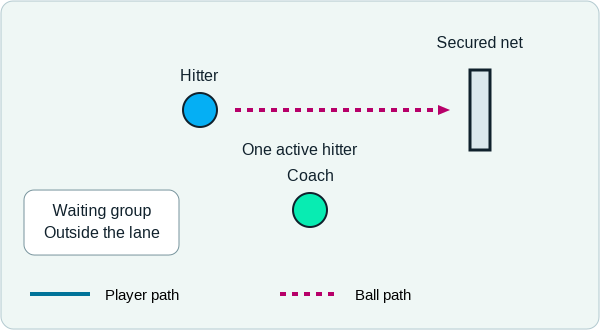
Choose a tee contact target
Setup schematic, not to scale or a body-mechanics demonstration. Blue solid = player route; pink dashed = ball path. Follow the written sequence; keep waiting players clear of swings, flight and rebounds. Mirror player footwork for left-handed players when needed.
Use one tee, helmeted hitter and secured net with a broad left and right target area. Coach stands clear; waiting players are outside all ball paths.
Coach names a broad area. Adjust tee position to comfortable contact, with bat down during adjustments; make a controlled swing toward that area.
Three attempts then rotate. Judge balance and direction, not power or a forced swing shape.
Say: See the target; stay balanced.
Rotate: two or three attempts, then change active player. Waiting players rehearse a bat-free ready position outside the lane. Stop the station before collection; stop all stations before group rotations.
Adapt and check readiness
Easier: Use the middle of the net.
Progress: Let the hitter name a target before the turn.
Check: Target choice does not cause lunging or loss of balance.
Age band is a starting point. Repeat the simpler task if attention, receiving or balance is unreliable.
F · Assistant 1 · 11 minutes including turns and explanation
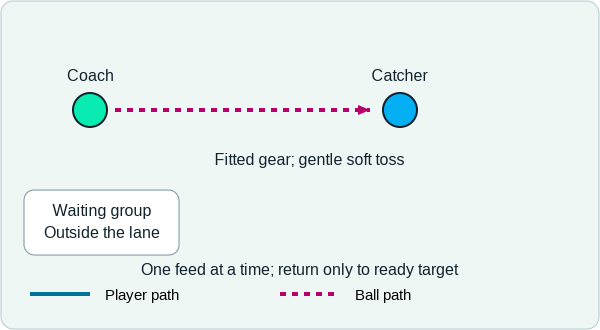
Catcher receive and transfer
Setup schematic, not to scale or a body-mechanics demonstration. Blue solid = player route; pink dashed = ball path. Follow the written sequence; keep waiting players clear of swings, flight and rebounds. Mirror player footwork for left-handed players when needed.
Use complete fitted catcher’s gear and soft balls. One catcher faces a coach; there are no live runners or batters.
Receive a gentle toss, bring the ball under control, transfer to the throwing hand and stand in balance toward an imaginary base. No throw is made.
Two feeds then rest and rotate with gear fitting. Keep the throwing hand protected until the ball is secured.
Say: Catch first; then transfer.
Rotate: two or three attempts, then change active player. Waiting players rehearse a bat-free ready position outside the lane. Stop the station before collection; stop all stations before group rotations.
Introductory position work. Check today’s throwing/rest eligibility; use the no-throw version when rest is required. No live batter. Gear fitting and rest count toward station time.
Adapt and check readiness
Easier: Transfer a ball already held in the glove while standing.
Progress: Add a verbal target after the receive.
Check: Transfer follows a secure catch and ends in balance.
Age band is a starting point. Repeat the simpler task if attention, receiving or balance is unreliable.
R · Assistant 2 · 11 minutes including turns and explanation
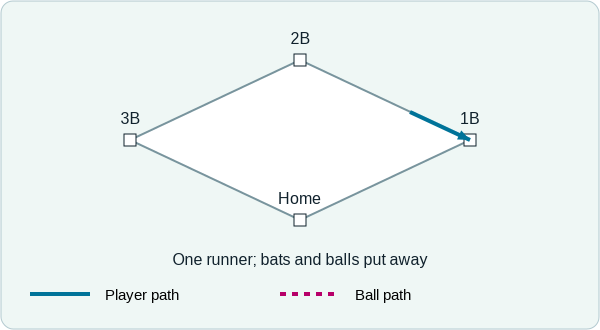
Fly-ball hold and return
Setup schematic, not to scale or a body-mechanics demonstration. Blue solid = player route; pink dashed = ball path. Follow the written sequence; keep waiting players clear of swings, flight and rebounds. Mirror player footwork for left-handed players when needed.
Use first base and a clear route; all bats and balls are put away. One runner works while others wait off the route.
Runner takes a short practice movement only as permitted by the division. Coach says caught; runner returns to touch the base before a pretend advance.
Walk the sequence and alternate caught versus down calls. No throws, tags, sliding or races. Local rules control when runners may leave.
Say: Caught? Return and touch.
Rotate: two or three attempts, then change active player. Waiting players rehearse a bat-free ready position outside the lane. Stop the station before collection; stop all stations before group rotations.
Adapt and check readiness
Easier: Start with the runner on the base.
Progress: Ask runner to explain the return on a caught ball.
Check: Runner distinguishes a caught fly from a ball that lands.
Age band is a starting point. Repeat the simpler task if attention, receiving or balance is unreliable.
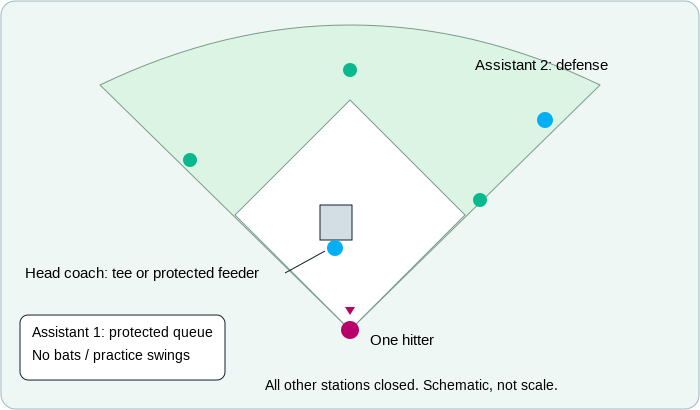
All other stations close during this block. Track a moving feed, choose a hittable pitch, communicate, field and back up; use the tee for the same defensive task when timing is not ready.
Schematic only. Actual screen placement, fielding depth, foul-ball coverage and protected waiting space must fit the field and equipment. Tee mode removes the screen/feeder from the batting lane.
Equipment: Full league field and bases; tee, bats, helmets, gloves, suitable balls, cones and buckets; inspected L-screen; league-approved pitching machine and manufacturer-required protection/power setup
Head coach: Trained adult operates the machine using its exact manual and protective setup; nobody stands in front of the machine.
Assistant 1: Controls the protected waiting area, calls one helmeted hitter, and gives the stop/advance instruction. Only the active hitter holds a bat.
Assistant 2: Sets spaced defensive roles, watches the whole field and stops play if someone is unready or a ball leaves the area.
Turns: Three fair contacts or five suitable feeds, then change hitter. Allow transition, instruction and water within the block; stop on time even if fewer contacts occur.
Stop every station. Put away idle bats and loose balls; establish a stop signal. Inspect the full fair/foul-ball area and protected waiting space. No parallel throwing, hitting or bullpen.
With no batter present, trained adult inspects and test-feeds the machine into a cleared field. Use approved balls, settings, guarding and distances from its manual; stop and isolate power/energy before adjustment or clearing a jam.
Start with no runners. Put defenders at appropriate depth for the actual hitter; begin farther back and move only on the coach’s stop. One fielder calls the ball, a teammate backs up, then return to one designated ready receiver away from the feeder/screen. No throws at the operator.
After each fair contact, stop feeding until the ball is controlled and everyone is reset. Start with the hitter staying at home. After readiness is established, use the final fair contact for one helmeted runner home to first; no tags, slides or throws to an occupied running lane. Stop before adding a new situation.
Use groups A/B/C. A supplies hitters, B starts infield, C starts outfield; rotate A/B/C roles every third of the block on a complete stop. Two to four hitters per small group; nobody takes practice swings while waiting.
Call stop before retrieval. Bats down; feeding stopped; machine isolated as its manual requires before anyone approaches. Coach releases collection only when all areas are quiet. Keep water and rest available.
Apply: Begin with no runners and an easy out at an unoccupied base. For ages 9–12, later rehearse a runner on first with one out: state the force and backup before the feed; walk it first, use controlled throws only when spacing and receiving are reliable. Local division rules govern leaving bases and game situations.
Catcher: No player catcher is required. Do not place an unprotected player behind the hitter. If a catcher is added, fit complete required gear, check readiness and throwing workload, and assign a coach to supervise the battery; reduce other active roles. Machine use must follow the manual’s catcher/backstop requirements.
Tee fallback: Use a tee at home and keep the same supervised field roles. If the full field or protected waiting space is unavailable, return to the separate station plan. Never substitute unprotected front toss.
Wrap-up: name one useful cue, recognize effort and collect on the stop signal.
Repeat, progress or simplify?
Transfer follows a secure catch and ends in balance. If this is inconsistent, repeat the simple feed. If comfortable, add only one movement or decision. Week numbers do not require advancement.
Original LFB plans and activity instructions, informed by the resources below. Timing, age adjustments and weekly sequencing are LFB coaching decisions. These are not official or endorsed league curricula. Reviewed October 21, 2026; updated when guidance or content changes.
Little League: tee hitting: Contact practice from a tee; LFB supplies timing, age adjustments and turn structure.
Use current local division rules for game formats, equipment and throwing limits. The series includes introductory position modules, not a complete pitching workload or specialist catcher program.