

Lee Family Baseball

TEE · COACH PITCH · MACHINE · FULL FIELD

Practice with the equipment you have

Use league equipment to connect hitting, fielding and baserunning. Choose a full-field session, or keep the familiar station practice. Confirm your league’s equipment access and operating rules.

Station and shorter options →

Choose equipment, age and setup

Ages 3–4: tee-first, soft balls, short bursts and a smaller group. Ages 5–6: tee or comfortable protected coach feeds when ready. Ages 7–12: tee, protected coach pitch or a league-approved machine when the player, operator and setup are ready. These are LFB planning choices, not official division eligibility rules.

Check the exact machine and screen manuals, approved balls, guarding, operating distances, speed/trajectory settings, power and shutdown instructions. There is no universal speed or distance. Adults operate machines; remove the batter for testing/adjustment, and isolate energy before jams or collection near equipment. If safe protection, reliable feeds or backstop requirements cannot be met, choose the tee session.

Use one inspected L-screen for protected coach pitch, oriented for the feeder’s throwing side. A screen is protection, not a guarantee: keep the feeder protected and never allow players to field near the screen or machine. A trained adult must assess the actual field and equipment.

Full-field means one shared batting activity, not several hitting stations. No simultaneous bullpen or side station. Protected waiting players do not hold bats. Helmet the hitter and runners; no on-deck swings. No player pitcher is used in these sessions.

Full-field tee batting · ages 3–4

60 minutes3 coaches6–12 players · prefer 6–9 for ages 3–4

One-page run sheet PDF · Full-field coach packet PDF

Run sheet

  1. 0–5 minMovement warm-up and stop signal
  2. 5–10 minEasy throwing / rolling with ready targets
  3. 10–13 minWater; put loose balls away
  4. 13–31 minBat-free team defense and base routes
  5. 31–34 minWater; clear field and inspect equipment
  6. 34–54 minFull-field batting and controlled application
  7. 54–60 minReview; stop and collect

Before batting: warm up in a clear area, then easy rolls/throws in parallel lanes with ready targets. For the bat-free team block, put bats away and walk field/backup responsibilities and one-runner base routes. Use a coach roll only after players understand their roles; do not use the machine for this block.

Matching drill cards: Tee contact into the field

FULL FIELD · ALL 3 COACHES · 20 MINUTES

Full-field tee batting

All other stations close during this block. Contact, safe bat placement, first-base direction and one-player fielding.
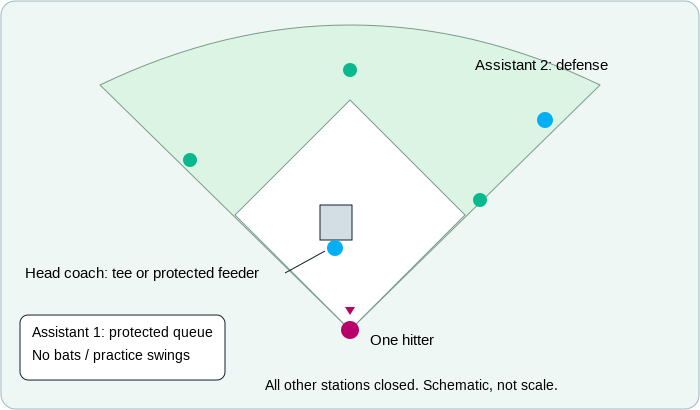
Full-field batting layout and three coach responsibilities
Schematic only. Actual screen placement, fielding depth, foul-ball coverage and protected waiting space must fit the field and equipment. Tee mode removes the screen/feeder from the batting lane.

Equipment: Full league field and bases; tee, bats, helmets, gloves, suitable balls, cones and buckets

  • Head coach: Sets the tee only with bat down; steps out of swing/ball paths and calls ready.
  • Assistant 1: Controls the protected waiting area, calls one helmeted hitter, and gives the stop/advance instruction. Only the active hitter holds a bat.
  • Assistant 2: Sets spaced defensive roles, watches the whole field and stops play if someone is unready or a ball leaves the area.

Turns: One fair contact, then change hitter. Allow transition, instruction and water within the block; stop on time even if fewer contacts occur.

  1. Stop every station. Put away idle bats and loose balls; establish a stop signal. Inspect the full fair/foul-ball area and protected waiting space. No parallel throwing, hitting or bullpen.
  2. One helmeted hitter starts at home plate. Set a comfortable tee height; coach clears the swing and ball path before calling hit.
  3. Start with no runners. Put defenders at appropriate depth for the actual hitter; begin farther back and move only on the coach’s stop. One fielder calls the ball, a teammate backs up, then return to one designated ready receiver away from the feeder/screen. No throws at the operator.
  4. After each fair contact, stop feeding until the ball is controlled and everyone is reset. Player puts bat down; on a separate coach signal, one runner travels home to first. Defense holds the ball until the runner is clear; no live throws, tags or slides against that runner.
  5. Give each player one contact opportunity before repeat turns; use the tee after a few unsuccessful feeds. Rotate hitter to a defensive role and bring the next player from defense to the waiting group on the stop signal.
  6. Call stop before retrieval. Bats down; feeding stopped; machine isolated as its manual requires before anyone approaches. Coach releases collection only when all areas are quiet. Keep water and rest available.

Apply: For ages 3–4 use soft practice balls, two or three spaced fielders and a short contact-and-run game; no machine or coach-pitch requirement.

Catcher: No player catcher is required. Do not place an unprotected player behind the hitter. If a catcher is added, fit complete required gear, check readiness and throwing workload, and assign a coach to supervise the battery; reduce other active roles. Machine use must follow the manual’s catcher/backstop requirements.

Tee fallback: Use a tee at home and keep the same supervised field roles. If the full field or protected waiting space is unavailable, return to the separate station plan. Never substitute unprotected front toss.

Full session, equipment guidance and printable field instructions →

Teaching and safety references

Original LFB practice structure. Little League Safety Code supports adult machine operation, equipment inspection and protective equipment. Little League’s 2015 coach-pitch teaching program demonstrates protected coach feeding; its historical rules and distances do not replace your current league rules or manufacturer’s manual. These references do not certify LFB plans or establish PONY policy.